
Past event!
This event has already taken place.
Find all current events for this promoter here.
I Maestri present: Rhapsodic Dreams
Presented by: I Maestri| 0 | LONDON: Holy Trinity Church |
|---|---|
| P | Sunday 12th March, 2017 |
| N | 7:00pm |
Event information
I Maestri’s March Concert explores two well know works by Rachmaninov and Sibelius which reflect the social and personal struggles of their homeland. Rachmaninov left Russia as he did not agree with the changes of the Russia he loved and Finland was undergoing its share of turmoil at the turn of the twentieth century, beginning to buckle with nationalistic fervour against the yoke of its Russian occupiers.
Concert Programme:
Rachmaninov - Rhapsody on a Theme of Paganini, Op. 43
Sibelius - Symphony No. 2 in D Major, Op. 43
Soloist: Mine Doğantan Dack - Piano
Conductor: George Hlawiczka
Rachmaninov left Russia a famous composer, a highly-esteemed conductor, and a distinguished (part-time) pianist. He was also a man troubled by the problem of keeping those three lives in balance. When word got out of his departure, he was offered the music directorships of the Boston and Cincinnati symphonies, but he decided not to take on the burden of such a position; indeed, he hardly ever conducted again. With a family to support and with pre-war Russian music not subject to international copyright, he resigned himself to the life of a traveling piano virtuoso, full-time. That, and his sense of exile, which he felt keenly in spite of his vast popularity here and the presence in this country of good friends and colleagues, had much to do with his off-and-on retirement as a composer.
Most of Rachmaninov’s late works found few friends when they were new. To this the Rhapsody on a Theme of Paganini was a happy exception. The piece begins not with Paganini’s theme but with an introduction, which is followed by Variation 1, the theme itself, Variations 2 through 24, and the coda. Rachmaninov takes the second half of Paganini’s first measure as his launching pad, using it over eight measures to build suspense. This is followed by the first variation on a theme not yet heard. It is a skeleton, but as the variation nears its close, it begins to assume flesh. The theme proper, when it appears, is assigned to the violins, while the pianist accompanies with the skeleton.
Sibelius’s 2nd Symphony was not intended, much like the others, but to be a series of four tone poems based on characters from Dante’s Divine Comedy. However, Sibelius began to recognize that what was forming out of his sketches was not a set of tone poems, but rather a full-fledged symphony with an overt expression of the political conflict then reigning over Finland.
The conductor Robert Kajanus, who would become a distinguished Sibelius interpreter, sated; “The Andante, strikes one as the most broken-hearted protest against all the injustice that threatens at the present time to deprive the sun of its light and our flowers of their scent… The Finale develops toward a triumphant conclusion intended to rouse in the listener a picture of lighter and confident prospects for the future.” Sibelius had not originally intended on such an interpretation, preferring that no programmatic implications be attached to this work. Nonetheless, this symphony does seem to express something specific to the Finnish imagination. The composer Sulho Ranta (1901-60) spoke on behalf of his fellow Finns when he declared, “There is something about this music—at least for us—that leads us to ecstasy; almost like a shaman with his magic drum.”
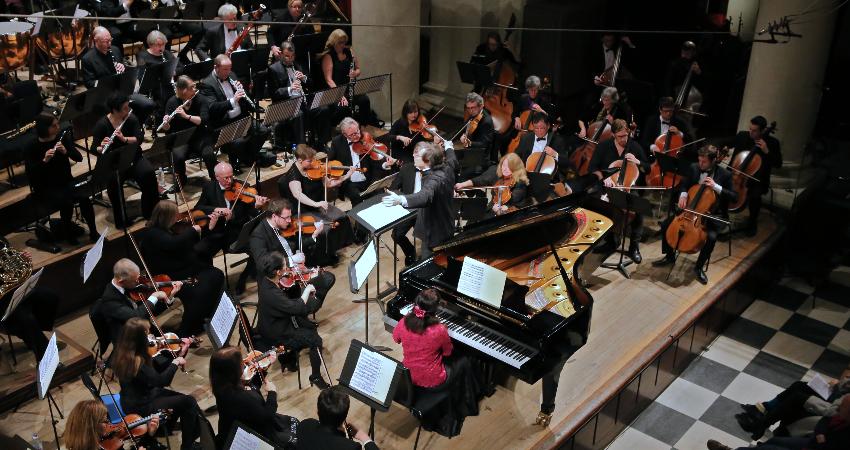
I Maestri is an established orchestra under the patronage of the late Sir Neville Marriner which gives a platform to aspiring conductors and soloists wishing to develop their experience and knowledge in an environment of mutual co-operation. The orchestra is made of the best orchestral players to the best amateurs as well as recently graduated students. I Maestri have helped soloists such as Nicola Bennedetti, Yuri Zhislin, Maxim Rysanov, Dóra Kokas and many others, in giving them a platform to explore their potential and develop their early musical careers in a more relaxed setting.
Box Office opens at 6:30pm
Please note that tickets will not be posted out and need to be collected from the Box Office on the day of the performance.
Venue information
LONDON: Holy Trinity Church| 0 | Prince Consort Road South Kensington London SW7 2BA |
|---|---|
| > | www.htsk.co.uk |
| ! | 07950 321294 |